
BEE Star Rating & Labels on Pumps: What They Mean
A guide to BEE star ratings and energy labels on water pumps in India — what the stars mean, how they affect running cost, and why they matter when buying.
Read More →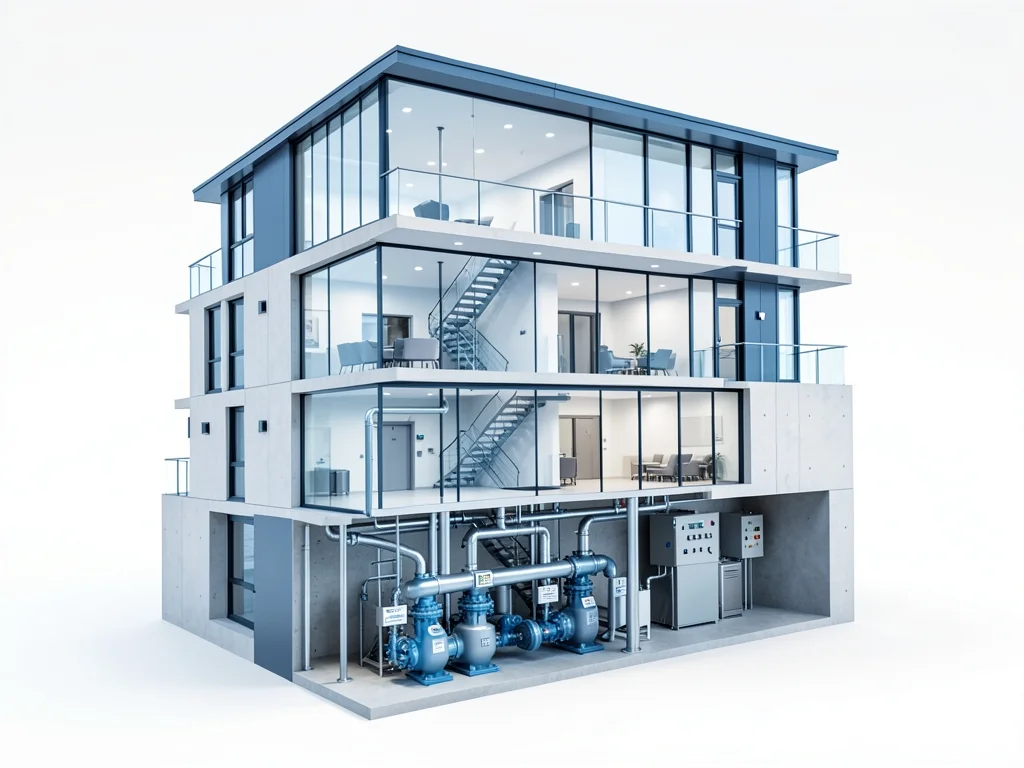
Choosing a pump for a multi-storey building comes down to one thing: getting adequate water pressure to the topmost floor. The taller the building, the more head (lifting height) your pump must deliver. This guide gives practical recommendations by building height.
1. Understand Head Requirement
Each floor adds roughly 3 metres of height. Add the overhead tank height, pipe friction, and a safety margin. A rule of thumb: total head needed = (floors × 3m) + tank height + 20% margin.
For example, a ground-plus-three building (4 levels) with the tank on the terrace: 4 × 3 m = 12 m, plus about 2 m to the tank inlet and 3 m of suction lift from the sump, is 17 m of static head. Adding 20% for pipes and bends gives about 20 m. Choose a pump that still delivers the flow you need at that head, reading from its performance table rather than its maximum head.
| Building | Approx. total head to terrace tank |
|---|---|
| Ground + 1 (2 storeys) | 12–14 m |
| Ground + 2 (3 storeys) | 16–18 m |
| Ground + 3 (4 storeys) | 19–22 m |
| Ground + 4 (5 storeys) | 23–26 m |
These figures assume about 3 m per floor, the pump at ground level drawing from a sump, and a short, straight pipe run. Long pipe runs or small pipes need more. You can also use our pump finder, which filters by water source, tank size and building height.
2. 2-Storey Home (up to ~7m)
A 1 HP monoblock or a 0.5-1 HP pressure booster is usually sufficient. For borewell source, a 1 HP submersible handles both extraction and delivery to an overhead tank.
3. 3-Storey Building (up to ~11m)
Step up to a 1.5-2 HP pump. If pressure at upper-floor taps and showers is the concern, add a dedicated pressure booster pump after the tank rather than oversizing the main pump.
4. 4-Storey Building (up to ~15m)
A 2-3 HP pump for tank filling, plus a pressure booster system to ensure consistent flow at the top floors. For societies, a multi-stage booster with automatic pressure control gives the best result.
5. Common Mistakes
Frequently Asked Questions
For filling a terrace tank on a ground-plus-two or ground-plus-three building, a 1 HP pump is usually enough for an individual house. For a society, or where the tank must fill quickly, 1.5 to 2 HP may be needed. Check that the pump gives the flow you need at about 18 to 22 m of head.
A monoblock or self-priming pump that delivers your required flow at around 20 to 25 m of head for tank filling, plus a pressure booster after the tank if the top floors need better tap pressure.
Often yes. The floors just below the terrace tank get very little pressure from gravity. A small booster pump after the tank gives good pressure at showers and taps on those floors.
Share your building height, tank position, and water source and we will size the exact pump you need. Contact us or send a pump inquiry for free sizing guidance.
A guide to BEE star ratings and energy labels on water pumps in India — what the stars mean, how they affect running cost, and why they matter when buying.
Read More →
A 2026 guide to the PM-KUSUM solar pump subsidy scheme for Indian farmers — covering eligibility, subsidy amount, the application process, and how to get started.
Read More →
A guide to choosing pumps for farmhouses and weekend homes in India — covering borewell supply, garden irrigation, and pressure needs for intermittently-used properties.
Read More →