
How to Read a Motor Nameplate
How to Read a Motor Nameplate
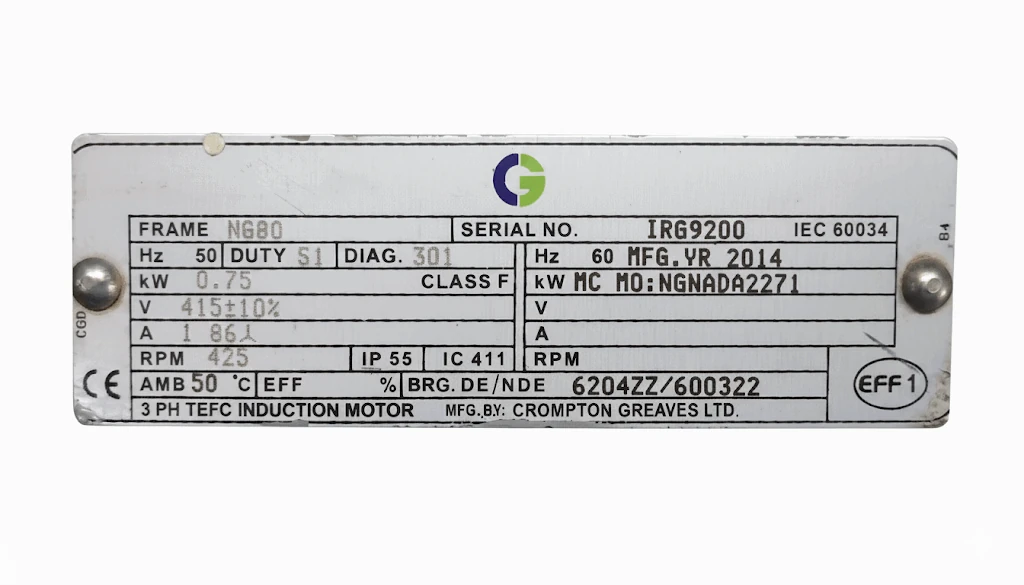
Every electric motor comes with a nameplate that acts as its identity card. Reading and understanding this data is essential for selecting, installing, and maintaining the correct motor for your application. CG Power motors, like all IEC-compliant motors, include standardized information on their nameplates.
1. Importance of the Motor Nameplate
The nameplate provides key technical specifications that ensure the motor is correctly applied. Incorrect interpretation can lead to overheating, poor efficiency, or even safety hazards.
2. Key Parameters on a Motor Nameplate
- Manufacturer & Model: Identifies the motor brand (e.g., CG Power) and series.
- Rated Power (kW / HP): Indicates the continuous mechanical output of the motor.
- Frame Size: Standard IEC frame size (e.g., 132M, 160L) defining shaft height and mounting.
- Rated Voltage: Operating voltage range, e.g., 415V ±10%.
- Frequency: 50 Hz (India) or 60 Hz (other markets).
- Full Load Current (Amps): Current drawn at rated load and voltage.
- Speed (RPM): Depends on frequency and number of poles (e.g., 4-pole ≈ 1500 RPM at 50 Hz).
- Power Factor (cos φ): Indicates efficiency of electrical to mechanical conversion.
- Efficiency (%): Shows how effectively input power is converted into output.
- Insulation Class: Thermal rating of motor windings (B, F, H).
- Protection Class (IP): Ingress Protection level (e.g., IP55 dust/splashproof, IP66 for outdoor).
- Duty Type: Continuous (S1), short time (S2), or other IEC duty cycles.
- Temperature Rise: Defines safe operating limits.
- Standards & Certifications: IS, IEC, ATEX, CMRI, etc. (important for flameproof motors).
3. Example Breakdown
For a typical CG Power motor nameplate reading:
- Power: 15 kW
- Frame: 160M
- Voltage: 415V
- Current: 27.5A
- Frequency: 50 Hz
- RPM: 1475
- Insulation: Class F
- Protection: IP55
- Duty: S1 (continuous)
This motor would be suitable for continuous operation in industrial applications requiring reliability and moderate efficiency.
4. Why This Matters
- Ensures compatibility with power supply and application load.
- Prevents overheating by matching insulation and duty cycle.
- Guarantees safety in hazardous areas with flameproof certification details.
- Simplifies replacement by matching frame size and power ratings.
Final Thoughts
The motor nameplate is more than a label – it’s a technical passport. By understanding each parameter, you can ensure the motor is installed correctly, maintained efficiently, and replaced accurately when needed. Bombay Engineering Syndicate, as an authorised dealer of CG Power motors, can guide you in interpreting and applying this information for your specific industrial or residential needs.
Contact us today for motor selection support, compliance documentation, and technical guidance.
By: Manish Chandrani; +919825014977