
HP to kW Conversion Made Easy: A Practical Guide for Motor Users
HP to kW Conversion Made Easy: A Practical Guide for Motor Users
Whether you're sizing a pump, selecting a VFD, or comparing OEM specs, converting between horsepower (HP) and kilowatts (kW) is an essential skill for motor users.
1. Why Convert HP to kW?
Globally, motors are rated in either HP or kW depending on regional standards. While HP is common in North America, kW is part of the international metric system (SI). Converting correctly ensures compatibility, avoids under-sizing, and helps with regulatory compliance.
2. Basic Formulas
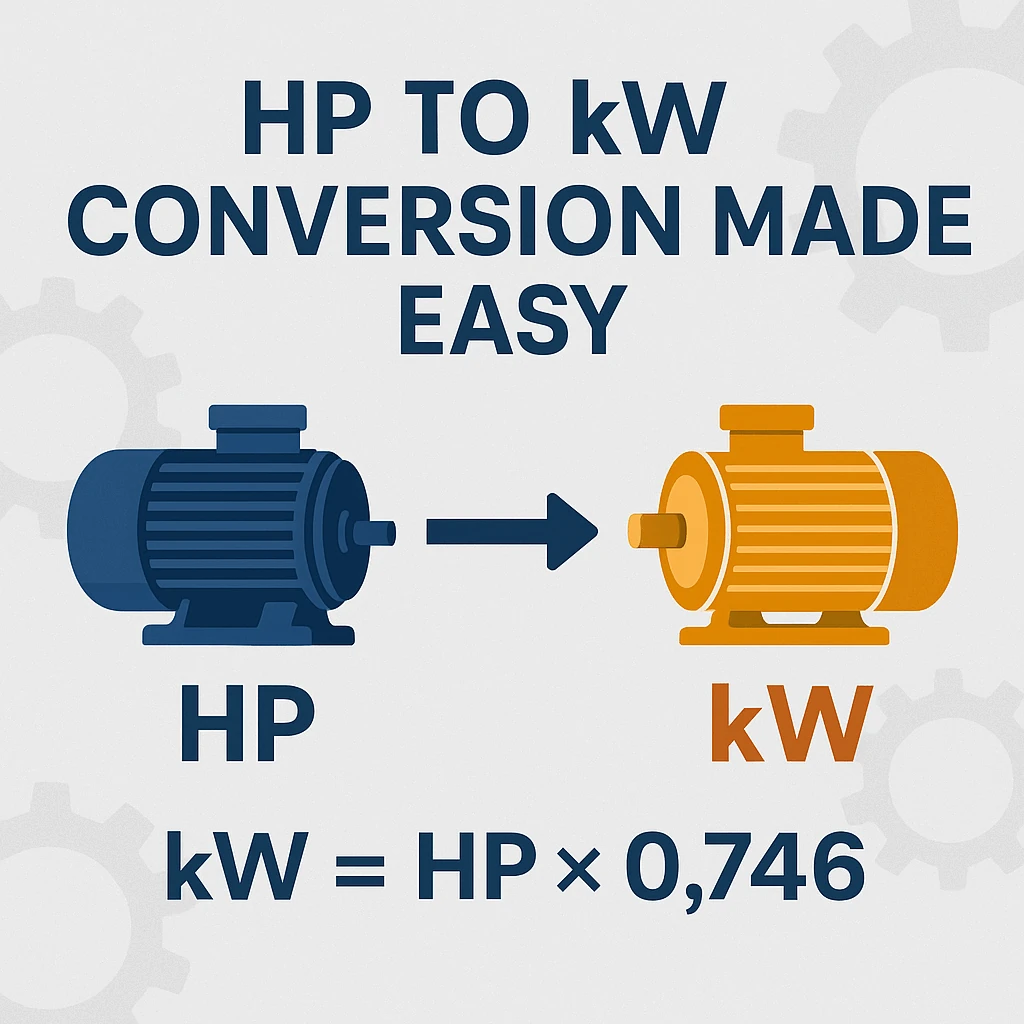
- kW = HP × 0.746
- HP = kW ÷ 0.746
These formulas are for mechanical HP. Electrical systems use the same conversion for rated output.
3. Real-World Examples
- 10 HP motor = 10 × 0.746 = 7.46 kW
- 15 kW motor = 15 ÷ 0.746 ≈ 20.1 HP
- 18.5 kW motor = 18.5 ÷ 0.746 ≈ 24.8 HP → Round up to 25 HP
4. Factors to Consider
- Efficiency: Motor efficiency impacts actual output. Consider losses.
- Voltage & Frequency: Ensure compatibility with your local supply.
- Service Factor: Overload requirements may affect size selection.
- Application Duty: Continuous vs. intermittent load types.
5. HP to kW Conversion Chart
| HP | kW |
|---|---|
| 1 | 0.746 |
| 3 | 2.24 |
| 5 | 3.73 |
| 7.5 | 5.60 |
| 10 | 7.46 |
| 15 | 11.19 |
| 20 | 14.92 |
| 25 | 18.65 |
| 30 | 22.38 |
| 50 | 37.30 |
| 100 | 74.60 |
6. Why It Matters in Motor Selection
- Ensures proper motor sizing
- Helps match VFD and starter ratings
- Aligns with consultant or tender requirements
- Improves load analysis during energy audits
7. How Bombay Engineering Syndicate Can Help
- Assist with power conversion and sizing queries
- Recommend CG motors suitable for your HP or kW specs
- Provide technical documentation for approvals
- Support in tendering, VFD matching, and retrofit projects
Final Thoughts
Converting HP to kW accurately is critical for efficient, safe, and compliant motor installations. A small error can result in under-sizing, overheating, or equipment failure. Trust Bombay Engineering Syndicate to help you size it right — every time.
Contact us today for motor sizing assistance or product selection.
By: Manish Chandrani; +919825014977