
Motor Protection Devices Explained: MPCBs, Overload Relays & Thermistors
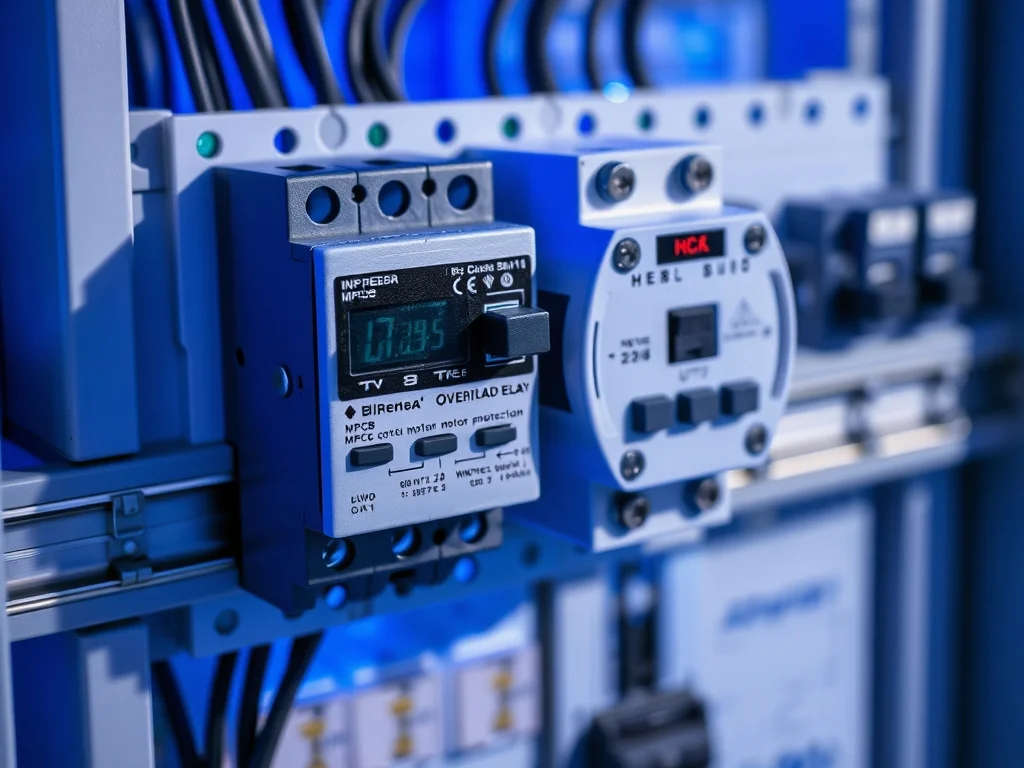
Motor Protection Devices Explained: MPCBs, Overload Relays & Thermistors
An electric motor is a major investment. Protecting it against short circuit, overload, single-phasing, and thermal damage is far cheaper than replacing it. This guide explains the four main types of motor protection devices used in modern industrial installations and helps you choose the right combination for your application.
1. What You Are Protecting Against
- Short circuit: Catastrophic fault (winding-to-winding, winding-to-earth, phase-to-phase). Must clear within milliseconds.
- Overload: Sustained current above rated, due to over-loading, jamming, or low voltage. Causes gradual winding overheating.
- Single-phasing: Loss of one phase in a three-phase supply. Remaining two phases overheat rapidly.
- Earth fault: Insulation breakdown to ground. Safety hazard.
- Over-temperature: Caused by overload, blocked cooling, hot ambient, or VFD-induced harmonics.
- Reverse phase: Wrong phase sequence on three-phase supply — motor runs backwards.
2. MCB / MCCB — Short-Circuit Protection
A Miniature Circuit Breaker (MCB) or Moulded Case Circuit Breaker (MCCB) protects against short circuit and gross overcurrent. They trip within milliseconds on a short circuit. However, standard MCBs are not optimised for motor inrush current — they may nuisance-trip during normal motor starting.
3. MPCB — The Best Single-Device Solution
A Motor Protection Circuit Breaker (MPCB) combines short-circuit protection (magnetic) with adjustable overload protection (thermal) in one compact device. The magnetic setting accepts motor inrush; the thermal element has a Class 10 trip curve specifically designed for motor protection.
- Protects against: Short circuit, overload, single-phasing (with phase-loss accessory)
- Setting range: Adjustable thermal trip from 0.6 to 1.0× rated current
- Best for: Motors 0.18 kW to 75 kW — most LV applications
- Advantage: Replaces both MCB and overload relay; saves panel space; resettable
4. Thermal Overload Relay (Bimetal)
A traditional overload relay uses three bimetal strips that heat up in proportion to current. When current exceeds the set value for the set time, the bimetal bends enough to trip the auxiliary contact, which opens the motor contactor.
- Protects against: Overload (mainly); some models include single-phasing detection
- Trip class: Class 10 (most common), Class 20 (high-inertia loads), Class 30 (heavy mining-type loads)
- Used with: Contactor + MCB (the standard "DOL starter" combination)
- Limitation: Cannot detect actual winding temperature — only inferred from current
5. PTC Thermistor / RTD — True Thermal Protection
For critical motors or motors with restricted cooling (frequently started, VFD-fed, hazardous area), embed PTC thermistors or RTDs (Resistance Temperature Detectors) directly in the stator windings. These measure actual winding temperature and trip the contactor when temperature exceeds class limits (e.g., 145°C for Class F).
- PTC thermistor: Inexpensive on/off device; resistance jumps sharply at trip temperature; needs a PTC-relay
- PT100 RTD: Linear analog signal; trends and pre-alarms possible; needs a PLC or dedicated RTD relay
- Best for: Motors ≥30 kW, hazardous-area motors, VFD-driven motors, motors with high duty-cycle
6. Recommended Protection by Motor Size
- ≤7.5 kW general purpose: MPCB + contactor
- 7.5–55 kW: MPCB + contactor + optional PTC thermistors
- 55–250 kW: MCCB + contactor + electronic overload relay + PT100 RTDs
- ≥250 kW or HV motors: Multi-function protection relay (overload, earth fault, differential, bearing temperature, vibration)
- Hazardous area (any size): Always PTC thermistors + appropriate Ex-rated starter
7. Sizing the Overload Element
The overload should be set at 100% of motor full-load current (FLC) for standard motors, or 115% if the motor has 1.15 service factor (NEMA design). For star-delta starters, set at 58% of FLC (because the relay sees phase current, not line current).
Bombay Engineering Syndicate stocks complete motor starter components — Crompton MPCBs, contactors, overload relays, PTC thermistors, and multi-function protection relays. Our application engineers help select and size protection for new installations and replacement projects. Contact us for panel design advice or to order matched starter components for your motor.