
Motor Rewinding vs Replacement: A Cost-Decision Guide
Motor Rewinding vs Replacement: A Cost-Decision Guide
When an industrial motor burns out, the immediate question is: rewind or replace? Rewinding often looks cheaper upfront — typically 30–50% of new-motor price. But rewound motors lose efficiency, and the energy penalty over years can far exceed the savings. This guide gives clear thresholds for deciding which path is right for your specific motor.
1. What Rewinding Actually Involves
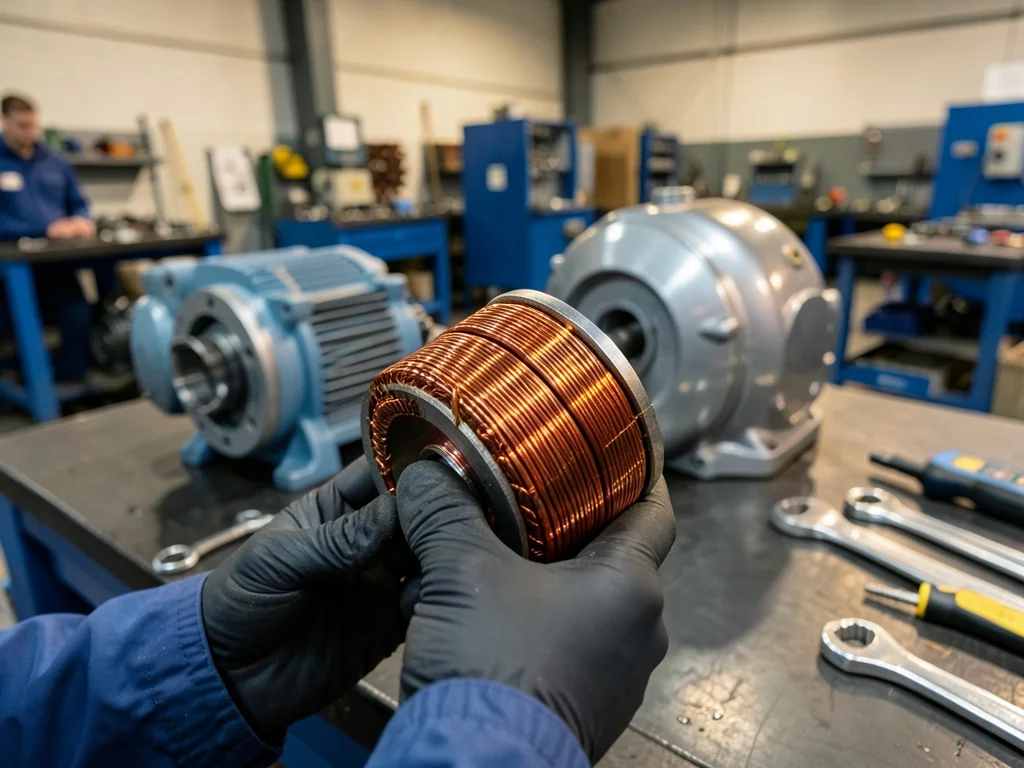
The repair process: strip the burnt stator windings, clean the stator core, install new copper coils, vacuum-impregnate with varnish, dry, test, and reassemble. Bearings are usually replaced. Done correctly by a skilled rewinder, the motor performs like new — almost.
2. The Hidden Cost — Efficiency Loss
Even the best rewinder typically loses 0.5–2 percentage points of efficiency. Reasons:
- Stator core damage from burnout (insulation between laminations breaks down, eddy current losses increase)
- Slight changes in winding geometry or copper density
- Increased temperature rise reduces winding lifetime
For a 30 kW motor running 6000 hr/year at PF 0.85, a 2% efficiency drop costs roughly:
30 kW × 6000 hr × 0.02 / 0.85 ≈ 4,235 kWh/year wasted
At ₹8/kWh industrial tariff = ₹33,800/year extra electricity. Over a 5-year remaining life: ₹1.7 lakh — likely more than the cost of a new IE3 motor.
3. When Rewinding Makes Sense
- Large motors (>100 kW): New motor cost is high; freight and installation add up; rewind cost may be 20% of new — economics still favour rewind
- HV motors (3.3 kV+): Replacement requires long lead times; rewinding is faster
- Custom or obsolete motors: Replacement isn't practical (special shaft, mounting, voltage)
- Critical/standby duty: Need to get back online quickly
- Motor already IE3 or better: Less to gain by replacing
- Few operating hours/year: Energy penalty is small in absolute terms
4. When Replacement Makes Sense
- Small motors (<7.5 kW): New motor is cheap; rewind costs 50%+ of new; energy penalty matters more relative to motor cost
- Old IE1/IE2 motor: Replace with IE3/IE4 — efficiency jump is large enough to justify even without rewind cost
- Burnt motor for the 2nd time: The stator core is permanently damaged; further rewinding gives diminishing returns
- High running hours (>5000 hr/year): Energy penalty dominates economics
- Motor over 15 years old: Bearings, shaft, frame have wear; replacement is cleaner
- Application changing: Need different speed, mounting, or duty cycle — start fresh
5. Decision Framework — Quick Rule of Thumb
Compute simple payback for replacement vs rewinding:
Payback (months) = (Replacement cost − Rewind cost) / Monthly energy savings from higher efficiency
If payback is under 24 months → replace.
If payback is over 48 months → rewind.
Between 24–48 months → look at motor age, criticality, and lead time.
6. Quality Indicators of a Good Rewind
If you choose to rewind, ensure the rewinder:
- Uses Class F or H insulation copper (not just Class B)
- Vacuum-impregnates with Class F+ varnish (not just dipping)
- Tests core losses before and after — won't accept jobs with >5% core loss increase
- Conducts surge test, HV test (typically 2× rated + 1 kV), and locked-rotor test post-rewind
- Provides a balance certificate (G2.5 minimum)
- Offers a written 1-year warranty
7. Energy Audit Before Deciding
For any motor above 30 kW, do a basic energy audit before deciding. Measure: actual operating hours/year, actual load profile, current efficiency (from kW input / kW shaft), and your electricity tariff. Many plants find that even a successful rewind of a 1990s IE0/IE1 motor still costs more than buying new IE3 — once you account for 10 more years of life at 5–6 percentage points higher efficiency.
Bombay Engineering Syndicate supplies new Crompton motors across the full power range — from 0.18 kW FHP units to 15 MW HV machines. We help customers make the rewind-vs-replace decision through quick energy audits, then supply the right replacement quickly. For motors with rewind potential, we coordinate with reliable rewinding partners. Contact us for honest advice and rapid replacement supply.