
Motor Vibration Analysis: Causes & Corrective Actions
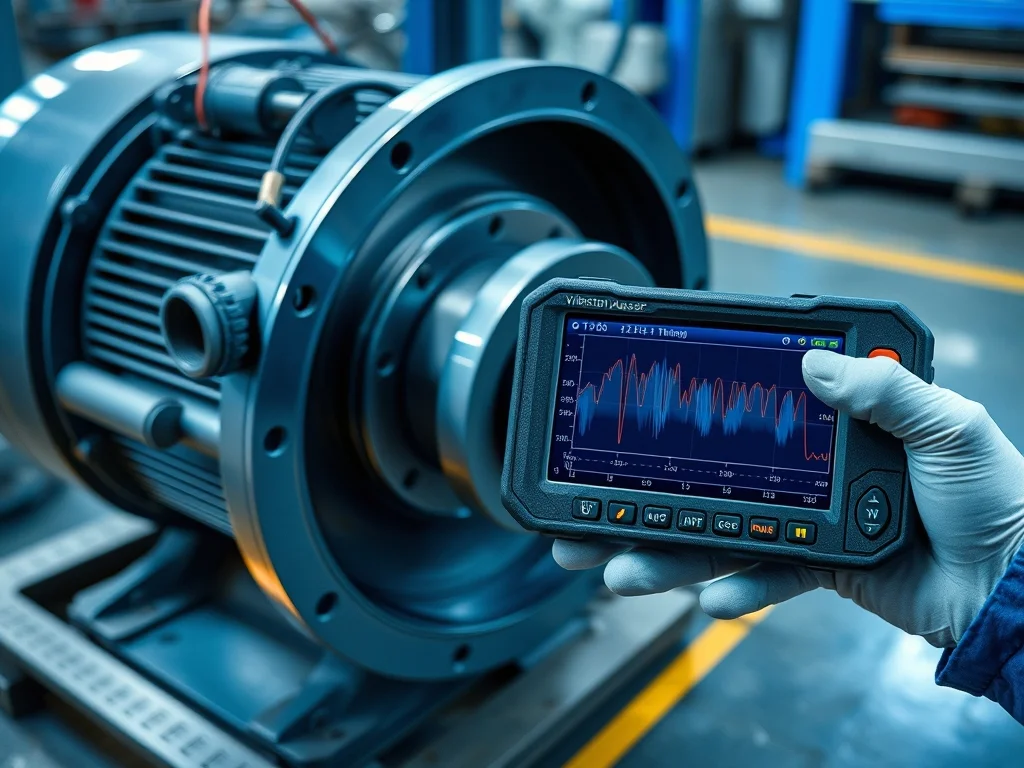
Motor Vibration Analysis: Causes & Corrective Actions
Vibration is the universal early warning of mechanical and electrical problems in motors. Smart maintenance teams treat vibration as a vital sign — monitoring it just as a doctor monitors pulse and blood pressure. This guide explains how to measure motor vibration, interpret the frequency content, and correct the most common faults before they cause catastrophic failure.
1. Measurement Basics
- Where to measure: Bearing housings — drive end (DE) and non-drive end (NDE), in three directions (horizontal, vertical, axial). Six readings per motor minimum.
- What to measure: Velocity in mm/s RMS (10–1000 Hz band) — this is the universal standard for industrial motor health monitoring (ISO 10816).
- Instrument: Handheld vibration meter (₹15,000–₹50,000), or portable analyser with FFT capability (₹1–5 lakh), or permanent monitoring system (for critical machines).
2. Acceptable Vibration Limits (ISO 10816)
For rigidly mounted motors 15–75 kW:
- < 1.8 mm/s: Good — new or like-new condition
- 1.8–4.5 mm/s: Acceptable for unrestricted long-term operation
- 4.5–11.2 mm/s: Unsatisfactory — investigate and correct
- > 11.2 mm/s: Unacceptable — risk of imminent damage
For larger motors (75–300 kW), shift each threshold up by ~1.0 mm/s. For motors mounted on flexible base, also shift up.
3. Frequency Analysis — Identifying the Cause
The frequency at which vibration appears identifies the cause. For a 4-pole motor at 1480 RPM (24.7 Hz running frequency):
- 1× RPM (24.7 Hz): Imbalance, bent shaft
- 2× RPM (49.4 Hz): Misalignment, looseness
- 3×–10× RPM: Bearing wear, broken rotor bars
- 2× Line Frequency (100 Hz): Electrical asymmetry, broken stator coil
- Vane-pass / blade-pass frequencies: Hydraulic or aerodynamic disturbance in pump/fan
- High frequency (> 1000 Hz): Cavitation, severe bearing damage
4. Imbalance — Most Common Cause
Imbalance shows up as 1× RPM vibration, mostly radial (horizontal or vertical). Causes:
- Worn or eroded fan blades / impeller
- Material buildup on impeller (scale, dirt)
- Missing or loose balance weight
- Bent rotor shaft
- Loose rotor laminations
Fix: Clean the impeller. If imbalance persists, professional balancing service (G2.5 grade is the standard for industrial motors). Specialised balancing machines reduce vibration to under 0.5 mm/s.
5. Misalignment
Misalignment shows 2× RPM vibration, both radial and axial. Causes:
- Pump and motor shafts not concentric (parallel misalignment) or not collinear (angular misalignment)
- Sole plate or baseplate distortion
- Pipe strain on pump casing pulling alignment off
- Thermal growth differential between motor and driven machine
Fix: Laser alignment is the standard. Target: <0.05 mm parallel offset and <0.05 mm/100 mm angular for solid couplings; up to 0.1 mm for flexible couplings. Always realign after any maintenance work.
6. Bearing Wear
Bearing problems start as high-frequency vibration (above 1000 Hz, often outside standard velocity measurement range) and progress to broadband vibration. Use enveloping or acceleration measurement for early detection.
Specific bearing fault frequencies (calculable from geometry):
- BPFO (Ball Pass Frequency Outer race): outer race defect
- BPFI (Ball Pass Frequency Inner race): inner race defect
- BSF (Ball Spin Frequency): ball defect
- FTF (Fundamental Train Frequency): cage damage
Fix: Replace bearings. Always replace as a pair (DE + NDE). Use the correct grease and quantity.
7. Electrical Faults
Vibration at 2× line frequency (100 Hz in India's 50 Hz system) suggests electrical problems:
- Stator turn-to-turn fault: Reduces magnetic balance
- Broken rotor bar: Sidebands around 1× RPM, distance = 2× slip frequency
- Air gap eccentricity: Rotor not centered in stator bore
- Voltage imbalance > 2%: Causes unequal magnetic pull
Test: Turn off the motor while monitoring vibration. If vibration drops within 0.5 seconds → electrical cause. If vibration coasts down with speed → mechanical cause.
8. Foundation and Looseness
Loose mounting causes vibration with harmonics at 0.5×, 1×, 1.5×, 2×, 2.5× RPM. Causes:
- Loose foot bolts
- Cracked or detached baseplate
- Foundation bolts losing grip in grout
- Shims falling out under feet
Fix: Check and torque all bolts. Replace cracked grout. Add proper shims (precision-thickness stainless steel).
9. Trending — The Real Value
A single vibration reading tells you little. Monthly readings trended over a year tell you everything. Trending reveals:
- Gradual bearing wear (catch before failure)
- Sudden imbalance changes (impeller deposit, lost balance weight)
- Step changes after maintenance (poor reassembly)
- Seasonal patterns (thermal effects, ambient changes)
Bombay Engineering Syndicate supports plants with vibration analysis services, calibrated handheld analysers, and Crompton bearings + impellers for fast repair turnaround. Our team can help establish vibration baselines for new installations and supports troubleshooting for plants experiencing recurring motor failures. Contact us for vibration audit or spare parts supply.