
Star-Delta vs DOL vs Soft Starter vs VFD: Motor Starting Methods Compared
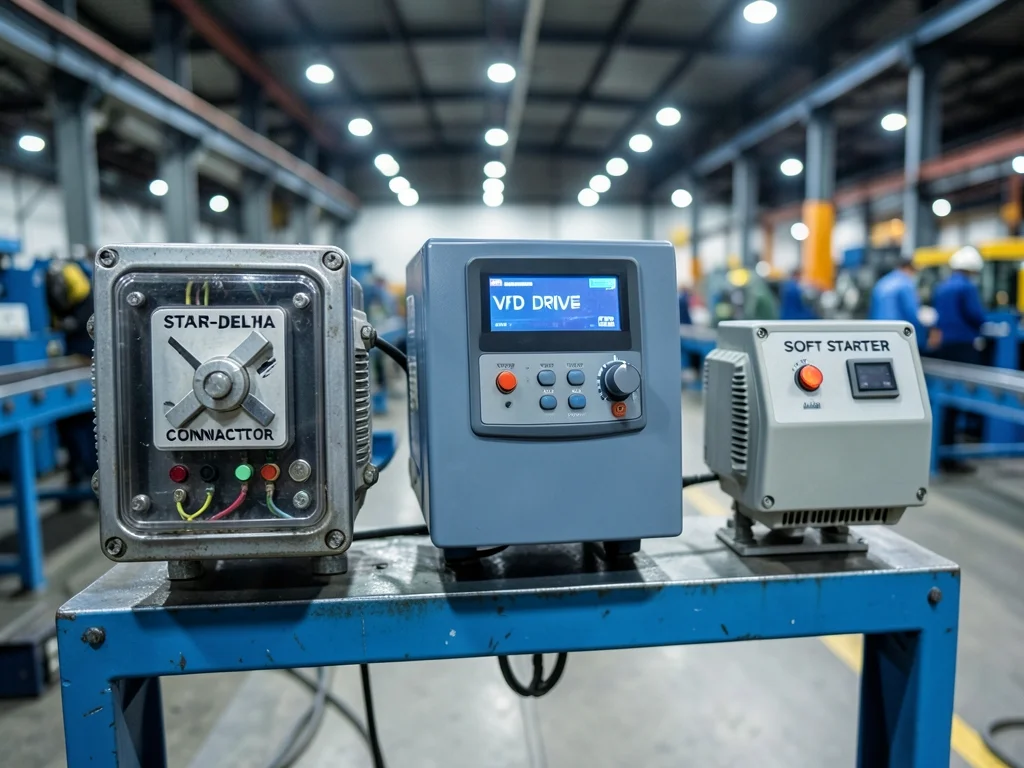
Star-Delta vs DOL vs Soft Starter vs VFD: Motor Starting Methods Compared
Starting a three-phase induction motor draws current that can be 6–8 times its full-load running current. This inrush stresses the motor, the supply network, and the driven equipment. The starting method you choose directly affects motor life, energy bills, and equipment reliability. This guide compares the four most widely used methods so you can pick the right one for your application.
1. Direct-On-Line (DOL) Starting
Direct-On-Line is the simplest method — the motor is connected directly to full supply voltage. It uses one contactor and an overload relay, making it cheap and easy to wire.
- Best for: Motors up to 7.5 kW where high starting torque is acceptable
- Starting current: 6–8× full-load current
- Starting torque: 1.5–2× full-load torque
- Drawback: Heavy mechanical shock on coupling and gearbox; large voltage dip on the supply
2. Star-Delta Starting
The motor windings start connected in star (Y), reducing applied voltage to 58% (1/√3) of nominal, then switch to delta (Δ) for full operation. This cuts inrush current to roughly one-third of DOL.
- Best for: Motors 7.5–55 kW driving low-inertia loads (fans, light pumps)
- Starting current: ~2.5× full-load current
- Starting torque: Reduced to 33% of DOL — not suitable for high-inertia loads
- Drawback: Requires 6 motor leads, two contactors, a star-delta timer; current and torque spike during transition
3. Soft Starter
A soft starter uses thyristors (SCRs) to ramp the motor voltage smoothly from zero to full over a programmable ramp time (typically 5–30 seconds). The result: gentle acceleration with no current spike at changeover.
- Best for: Pumps, compressors, conveyors where mechanical shock must be minimised
- Starting current: Adjustable, typically 2.5–4× full-load current
- Starting torque: Adjustable
- Drawback: Higher cost than DOL/Star-Delta; produces harmonics during start (acceptable for short duration)
4. Variable Frequency Drive (VFD)
A VFD takes the AC supply, converts it to DC, then synthesises a controllable AC waveform of variable frequency and voltage. The motor sees smooth, near-zero starting current and full torque at any speed.
- Best for: Process applications requiring speed control, frequent starts, or energy savings on variable-load pumps, fans, blowers, conveyors
- Starting current: ~1× full-load current
- Starting torque: Full torque available at zero speed
- Drawback: Highest capital cost; produces harmonics and high dv/dt voltage that may require motor insulation upgrades (VFD-duty windings)
5. Quick Decision Guide
- Small motor (≤7.5 kW), simple application: DOL
- Mid-size motor, fixed speed, light load: Star-Delta
- Pump/conveyor needing smooth start, no speed control: Soft Starter
- Need speed control or major energy savings on variable load: VFD
6. Energy Impact
On a 30 kW centrifugal pump running 12 hours a day at varying load, a VFD can cut energy use by 30–50% versus a DOL/Star-Delta setup. The capital cost difference often pays back in 12–18 months. Combined with IE3/IE4 motors, VFDs are the foundation of any modern energy-efficient drive system.
Bombay Engineering Syndicate stocks complete starting-method portfolios — DOL contactors, Star-Delta panels, soft starters, and VFDs from Crompton and partner brands. Our application engineers help size and specify the right solution for your motor and load profile, ensuring you balance capital cost, energy savings, and equipment protection. Contact us for project sizing, panel design support, and post-installation tuning.