
Motor Overload Relay: How It Works, How to Set It, Why It Trips
Motor Overload Relay: How It Works, How to Set It, Why It Trips
Almost every motor that burns out on a site had an overload relay sitting right next to it. Either it was set wrong, it was the wrong type for the job, or someone turned it up to stop “nuisance tripping” the week before. A correctly set overload relay is the cheapest insurance a motor can have. Here is how it works, how to choose one, and how to set it so it protects the motor instead of just decorating the panel.
1. What an Overload Relay Does
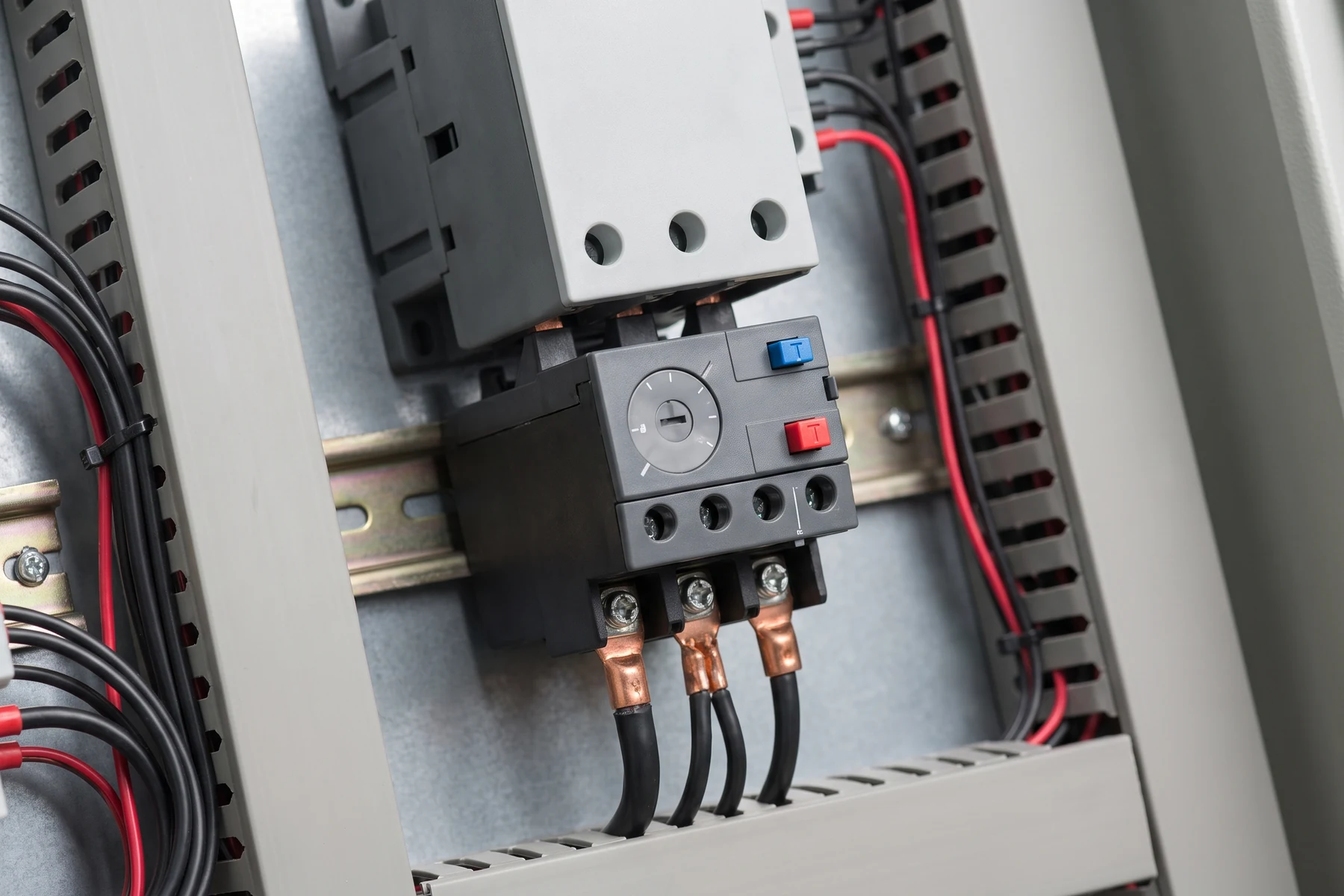
A motor overload relay watches the current the motor draws and trips the starter if that current stays too high for too long. It sits after the contactor in a DOL or star-delta starter, and its auxiliary contact (the 95–96 normally-closed contact) is wired into the contactor coil circuit. When the relay trips, that contact opens, the contactor drops out and the motor stops.
The key word is time. A motor draws 6–8 times its full-load current for a few seconds every time it starts, and that is normal. What damages a motor is current that is only 10–50% too high but continues for minutes — enough to cook the winding insulation slowly. The overload relay is designed to ignore the short starting surge and act on the long, moderate overload.
2. What It Does NOT Do
An overload relay is not short-circuit protection. A short circuit produces thousands of amps in milliseconds; the relay is far too slow and will be destroyed long before it reacts. Short-circuit protection comes from the fuse, MCCB or MPCB upstream. Every motor feeder needs both: short-circuit protection for faults, overload protection for the motor.
3. The Three Types You Will Meet
- Thermal (bimetallic) overload relay — the most common. Motor current passes through small heaters that warm three bimetal strips; on sustained overload the strips bend far enough to trip a latch. Simple, cheap and reliable. Buy the ambient-compensated type, otherwise a hot panel in a Mumbai summer will cause trips on its own.
- Electronic overload relay — measures current with built-in current transformers and calculates motor heating electronically. Wider setting range, selectable trip class, much faster and more reliable phase-loss detection, and not affected by panel temperature. Worth it on motors above roughly 30 kW and on critical duties.
- Motor protection circuit breaker (MPCB) — combines a thermal overload element with a magnetic short-circuit trip in one unit. Common on small motors up to about 30–40 A, where it replaces a separate fuse plus relay.
4. Trip Class: How Fast It Trips
Trip class tells you the maximum time the relay takes to trip at 7.2 times its set current (IEC 60947-4-1):
| Trip class | Trips within (at 7.2× setting) | Use it for |
|---|---|---|
| Class 10 | 4–10 seconds | Standard duty: pumps, compressors, conveyors that start quickly |
| Class 20 | 6–20 seconds | Loads that take longer to accelerate: large fans, blowers, loaded conveyors |
| Class 30 | 9–30 seconds | Heavy-inertia starts: crushers, centrifuges, large ID fans |
Most thermal relays are Class 10. If a motor trips every time it starts even though running current is normal, the load is simply taking longer to reach speed than a Class 10 relay allows — the fix is a Class 20 or 30 relay (usually electronic), not a higher current setting.
5. How to Set It Correctly
- Read the full-load current (FLC) from the motor nameplate at your supply voltage (415 V in most Indian plants). Not the kW, not a chart — the nameplate current for this motor. Our nameplate guide shows where to find it.
- Choose a relay whose adjustment range brackets that current, ideally with the FLC in the middle of the range rather than at the very top.
- Set the dial to the nameplate FLC. For an IEC motor with service factor 1.0 (most motors sold in India), that is the setting — no extra margin. Only a motor with a service factor above 1.0 allows a slightly higher setting; see our service factor explainer.
- Star-delta starters are the exception (see star vs delta wiring). When the relay is placed in the motor winding circuit (the usual arrangement, after the main contactor), it only sees phase current, so set it to FLC × 0.58 (FLC ÷ √3). A 22 kW motor with a 40 A nameplate current gets a setting of about 23 A. Setting it to 40 A here means it effectively gives no protection at all.
- Select manual reset (the “H” or “M” position on most relays). Auto-reset restarts a motor as soon as the relay cools — dangerous on machinery, and on a pump it lets a fault cycle the motor on and off until the winding fails.
- Press the test button once after installation to confirm the 95–96 contact actually drops the contactor.
6. Why an Overload Relay Keeps Tripping
A tripping relay is almost always telling the truth. Before touching the setting, check these, in this order:
- Low or unbalanced supply voltage. A motor on 380 V instead of 415 V draws more current for the same load. Measure voltage at the motor terminals under load.
- Single phasing. A blown fuse or loose lug on one phase makes the other two carry far more current. This is the classic motor killer — see single phasing explained.
- Genuine mechanical overload. Tight bearings, misalignment, a jammed conveyor, a belt that is too tight, or a pump running far to the right of its curve (open discharge, no head) pulling more power than the motor is rated for.
- Relay set below nameplate current, or a star-delta relay set for the wrong position.
- Too many starts per hour. Each start heats the motor; frequent starting accumulates heat faster than it can escape.
- Hot panel. A non-compensated thermal relay in a panel at 50°C trips early. Ventilate the panel or change to an ambient-compensated or electronic relay.
- Tired relay. Heaters that have tripped many times, or burnt terminals, drift in calibration. Replace the relay — it is far cheaper than a rewind.
7. The Mistake That Burns Motors
Turning the dial up until the tripping stops. The relay stops tripping because it has stopped protecting. The overload is still there — it is just cooking the winding silently now, and the next call is for a rewind or a new motor. If a relay trips, find the cause from the list above. If the setting genuinely has to go above nameplate current to keep running, the motor is undersized for the job and needs replacing with a larger frame, not a braver setting.
8. With a VFD or Soft Starter
A variable frequency drive has electronic motor overload protection built in. Enter the motor’s nameplate current in the drive’s motor parameters and the drive protects the motor itself; an external thermal relay is usually unnecessary for a single motor (and a thermal relay on a VFD output is unreliable anyway). Most soft starters also include motor overload protection with a selectable trip class, which suits heavy-inertia loads well.
9. Quick Checklist
- Relay range brackets the nameplate current
- Set to nameplate FLC (or FLC × 0.58 in a star-delta winding circuit)
- Trip class matches the load’s starting time
- Ambient-compensated or electronic relay in hot panels
- Manual reset selected
- Short-circuit protection (fuse / MCCB / MPCB) present upstream
- Test button checked after installation
Motor tripping and not sure whether it is the relay, the supply or the motor? Talk to us — share the nameplate and what the relay is set to, and we will help you find the real cause before it becomes a burnt winding.